



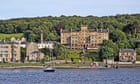
Rothesay’s decline as a seaside resort is not unique, but its beauty most certainly is | Ian Jack

Perhaps the visitors who crush into Skye might turn left at Glasgow next time, towards this lost resort
The Glenburn Hotel in Rothesay, on the island of Bute, has one of the finest views in Britain; quite possibly the loveliest afforded from any of our big seaside hotels. The Grand in Scarborough, the other Grand in Brighton, the Imperial in Blackpool: from their best rooms, the view is of nothing but a stretch of promenade followed by the empty sea and the sky. But the Glenburn looks over a bay where ferries and fishing boats come and go, and yachts ride at anchor against a backdrop of hills that are cut into by the narrows known as the Kyles of Bute and by a sea loch, Loch Striven, sometimes described as “gloomy”, which has hardly more than half a dozen houses dotted along its eight-mile length. This is a complicated and contrasting geography, in which a Highland landscape, all fish farms, heather and sheep, can be viewed from a comfortable lowland town that once had three cinemas, concert parties with chorus girls and a fleet of electric trams.
From the Glenburn’s iron veranda, 107 steps lead down to the sea, through a terraced garden filled with Bute’s typical flora: New Zealand cabbage palms, foxgloves, hydrangea, rhododendron. Perhaps Mrs Craik, the Victorian three-decker novelist, sat here to write her poem, Sweet Rothesay Bay, which became a melancholy popular song, sung by home-going crowds on pleasure steamers and corseted women standing beside upright pianos. The hotel is of her era. In the 1840s, the fashion for hydropathy, the water cure, reached Britain from Germany and took a particular hold in Scotland – oddly, given the country’s easily accessible and free-of-charge wetness – which built many more hydropathic hotels than England, Wales or Ireland ever did.